






 Trap
 Normal
Expendable Dai
View:
3419
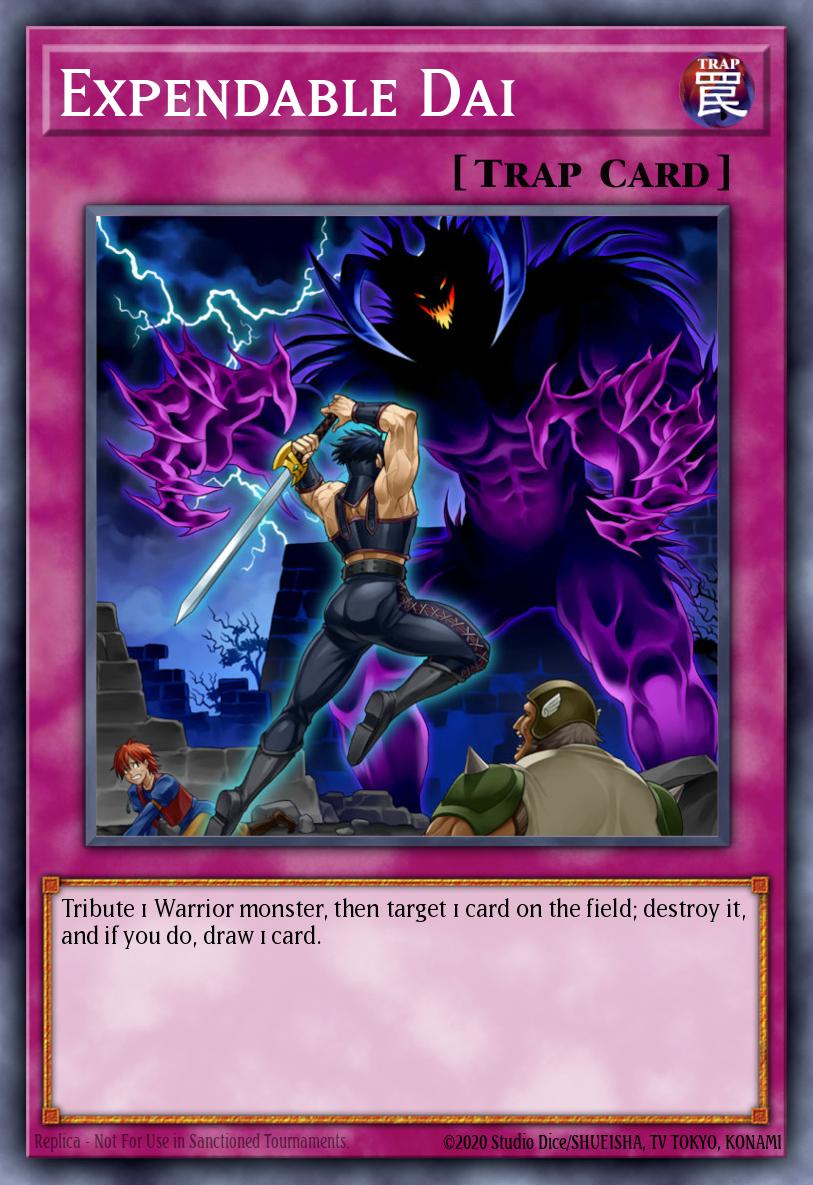
Tribute 1 Warrior monster, then target 1 card on the field; destroy it, and if you do, draw 1 card.
Expendable Dai — Power Evaluation
Final Score: 57 ± 8 · Confidence: Medium
- Intrinsic: 57.2 · Deck: 57.1 · Meta: provisional
- Primary role: Removal / Negation
Why it scores here
Expendable Dai is a flexible, targetable removal trap: it can destroy any one card on the field, and it draws a card when it does. Its real cost is a Warrior tribute plus the trap itself, so it is roughly a 2-for-2 exchange with a cantrip, not card advantage. Its 400-deck presence across 34 archetypes confirms it is a practical, portable staple (guardrail 3), but no combo or searcher evidence was supplied, so the score does not rise above the mid-50s. High deck inclusion, the Destiny HERO partner density and the Warrior-tribute access did not earn extra points on their own.
Axis scores
| Axis | Score | Evidence |
|---|---|---|
| Accessibility | 60 | Set trap that needs a Warrior monster to tribute; 400/400 sampled decks run it at 2.08 average copies, but no as_starter or as_searched combo data exists (observed from decks, inferred for live-ness). |
| Combo & Conversion | 35 | Text is a single removal-plus-draw with no combo steps; zero combo appearances in the supplied boards (inferred from text). |
| Resource Economy | 40 | Costs the trap and a Warrior monster, then draws 1 if it destroys something, so net about -1 for the user and -1 for the opponent (verified from text). |
| Effect & Interaction | 58 | Destroys any targeted field card, which is flexible, but it is a trap gated by its tribute cost and easy to negate (verified from text, inferred for the negation risk). |
| Material Utility | 5 | A trap card is not material, so this axis is near zero (verified from card type). |
| Resilience & Flexibility | 45 | Set-zone trap that a single negation or the tribute requirement can stop; no counter-trap evidence was supplied (inferred). |
| Deck-Building Efficiency | 70 | Cheap to run with no garnet or lock, and it appears at 1 to 3 copies across many archetypes (observed from decks). |
Calculation
Weight profile: Removal / Negation primary weights, no secondary role blend. Intrinsic ≈ 57.2, Deck ≈ 57.1, Meta = provisional. Modifiers: none. Final formula: 0.40*Intrinsic + 0.60*Deck
Strengths
- Flexible destroy-any-card removal that is not limited to a monster zone
- Draws a card on success, which softens the card cost
- Portable across 34 archetypes with no garnet or lock cost
- Live in the Destiny HERO core and in several other archetypes
Weaknesses
- Requires a Warrior monster to tribute, which costs a body
- Trap speed and single-use timing make it easy to negate
- Net card economy is about -1 for the user even when it succeeds
- No material value, so the card does nothing when it is not in use
Counters / choke points
- Trap negation on the activation
- Opposing backrow or floodgate that stops trap activation
- Lack of a Warrior tribute body in hand or on field
Best use
Flexible removal trap with a card of draw on success. Decks: Destiny HERO, Elemental HERO, Gouki, Phantom Knights.
Evidence & gaps
- Verified: Text: tribute 1 Warrior monster, then target 1 card on the field, destroy it, and if you do, draw 1 card; Deck evidence: 400 of 400 sampled decks run it, 34 distinct archetypes, average 2.08 copies
- Observed: Top partners include Book of Moon, Knightmare Phoenix and Reinforcement of the Army; Destiny HERO is 38.2% of the sample, Elemental HERO 15.8%, Gouki 13%; Five guides mention the card in staple or tech sections
- Inferred: Removal / Negation is the primary role based on text; Destiny HEROs and other tribute targets are Warriors, so the tribute cost is usually payable; Negation risk on activation, because it is a trap
- Data gaps: no combos supplied, so combo conversion is text-only inference no banlist token, assumed 3 copies (unlimited) no usage statistics (StatisticsCard), so archetype inclusion is inferred from the deck sample only no counter or negation evidence for trap interaction sample of 400 decks may be biased toward the card; the 400/400 presence is not a general-play rate